Empirically, it has been found that α rubber ≈ 2.5 · α glass. From the equation above we can drive the formula for the increase in length.

Large Volumetric Thermal Expansion Coefficients (Α V ) Reported For... | Download Table
Let, the initial volume of a substance be v 1 and the initial temperature is θ1.
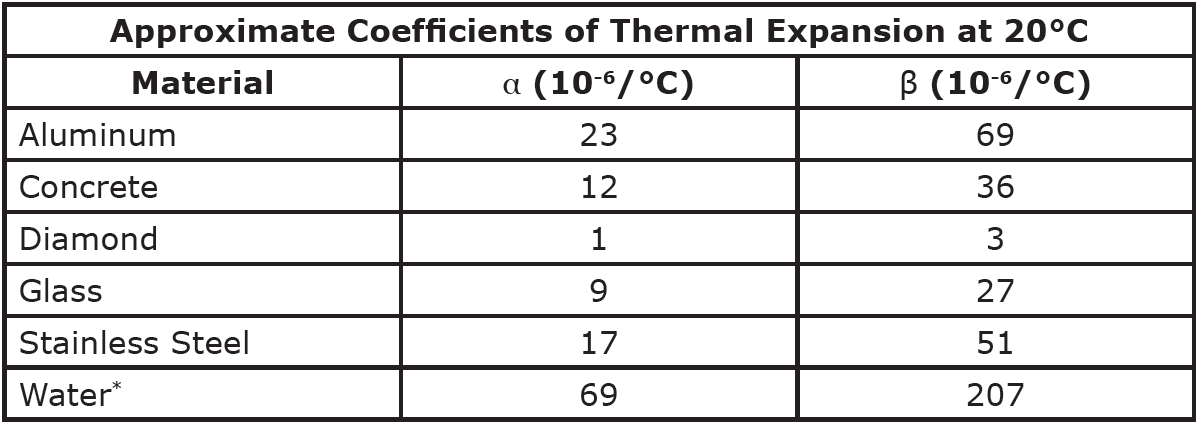
Coefficient of volume expansion table. Volumetric expansion coefficients of common fluids. The volumetric coefficient for water is negative below 4 o c and indicates that the a volume decreases when temperature moves from 0 o c (32 o f) to 4 o c. Tk = tc + 273.16.
Table of coefficient of expansion of building materials questions & answers about the thermal expansion or contraction of buildng materials as temperatures vary. 17,18 using the values of. Per 1 degree celsius of temperature rise.
Where δv is the change in volume, α v is the volumetric coefficient of expansion, δt is the change in temperature from the initial temperature associated with v 0, the initial volume. Solutal volume expansion coefficient qr/qc i from ref. Thermal expansion coefficient of metals & materials:
1 ft (foot) = 0.3048 m. For materials that are not isotropic such. Tr = tf + 459.67.
Coefficient of thermal expansion at 293 k. With the inclusion density increasing from 3990 to 5000 kg/m³, the removal ratio of the 1 μm inclusion decreases by 14.5 pct in the tundish without ceramic filter, and after using the ceramic. To a first approximation, the change in length measurements of an object due to thermal expansion is related to temperature change by a coefficient of linear thermal expansion (clte).
To estimate experimentally the temperature coefficient of volumetric expansion, the temperature dependence of the specific volume of the polymer is determined. Now if the coefficient of volume expansion is represented by. When the temperature is raised to θ2, its volume becomes v 2 after being increased.
Δv = α v δt v 0. The coefficient of expansion =. Coefficient of linear thermal expansion (approx.
The volumetric expansion coefficient is in average three times the linear expansion coefficient. ∂as ∂t = 2αs(t)as (5) ∂vs ∂t ' 3αs(t)vs (6) typical values of αs are shown in table 1 for some common metals and materials of construction. 40 rows volumetric coefficient of expansion (1/k, 1/ o c) acetic acid:
The ratio of the molar volume at 298k and the. A change in volume with respect to temperature can be understood mathematically in the following way: Coefficient of thermal expansion relative value;
The coefficient of linear expansion may be defined as the increase in length per unit length when the temperature is raised 1°c. The equation δ l = αl δ t is accurate for small changes in temperature and can be used for large changes in temperature if an average value of α is used. Thus if the temperature of a rod of length l0 is raised from 0°c to t °c, the new length, lt, will be given by.
Ontario, 25th ed., 2012, is a bound volume of more than 450 illustrated pages that assist home inspectors and home owners in the inspection and detection of problems on buildings. This calculator can be used to calculate expansion volume when initial volume and initial and final densities for the liquid are known That is its volume expands.
American elements toolbox of conversion tables, properties, identifiers and size charts Thermal expansion coefficients at 20ºc [2] material. 57 rows this table presents the linear thermal expansion coefficient values for metals and alloys.
Change in length = 0.0000188 200 50. The equation is only exact in the limit of d t, d v → 0 because the. 2d (area) or 3d (volume) can be related to the linear coefficientof thermal expansion 1:
The volumetric temperature expansion coefficient (β) for water is 0.0002 per degree celsius. Coefficient of linear expansion α (1/ºc) coefficient of volume expansion β (1/ºc) solids. For example the volume expansion coefficient of water at 20°c is 0.000207.
So if we take one cubic metre of water (so v = 1) and heat it by 1 degree (so d t = 1) we get: Thus, for most solids the coefficient β p is positive, typically 10 −5 and tables are available for many engineering materials bolz and ture (1970). 1 in (inch) = 25.4 mm.
(21.1) l t = l 0 + l 0 · αt = l 0(1+ αt) The table below lists the volumetric expansion coefficients for some common polymers. There are many recorded values for α.
D v ≈ 0.000207 × 1 × 1 = 0.000207 cubic metres. To solve this system of equations is described in our previous articles. Compare the experimental values for the coefficient of linear expansion with those found in the table.
Increase/decrease in length original length. Use these numbers (and any other observations that you can Schematic representation of the dependence of specific volume v on temperature t (dilatometric curve) (rate of heating.
Schematically, this dependence is depicted in figure 13. The thermal expansion coefficient is defined as the fractional increase in the linear dimension of a sample of a substance with increase in temperature at constant pressure. Note the use of the approximately equal sign ≈.
When an object is heated or cooled, its length change by an amount proportional to the original length and the change in temperature. As shown by table 1, liquid thermal expansion is much larger than steel thermal expansion and Linear expansion means change in one dimension (length) as opposed to change in volume (volumetric expansion).
It is the fractional change in length per degree of. Length of the brass rod at the temperature of 0°c = 200 inches.

Large Volumetric Thermal Expansion Coefficients (Α V ) Reported For... | Download Table
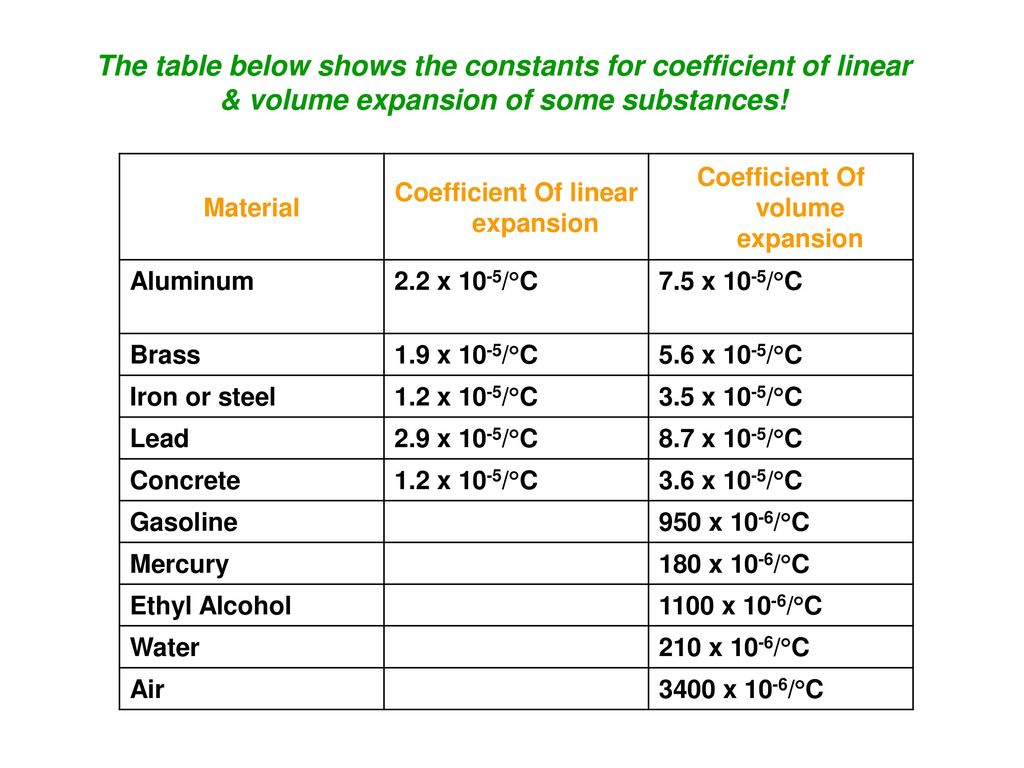
Expansion In Solids And Liquids - Ppt Download
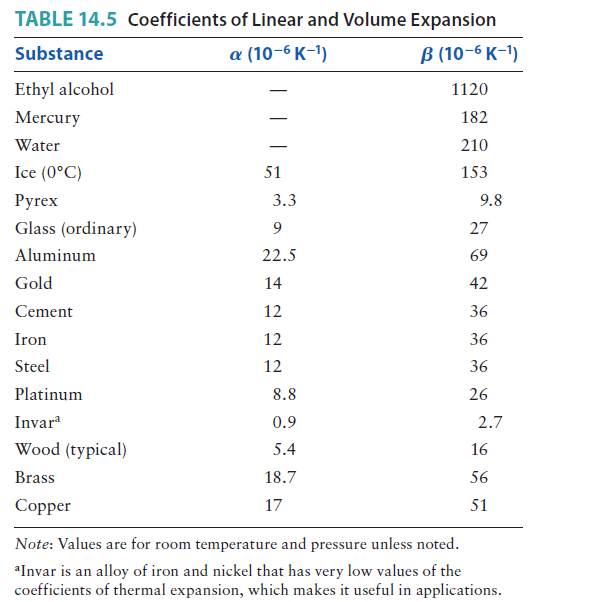
Solved: You Can See From Table 14.5 That A Substance With A Large ... | Chegg.com
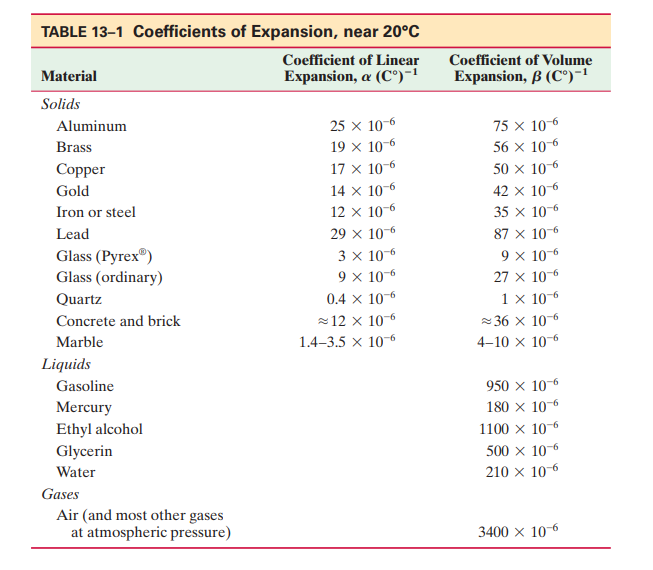
Answered: Table 13-1 Coefficients Of Expansion,… | Bartleby

Comparison Of The Volume Expansion Coefficient Obtained From The... | Download Table