Generally called the approach temperature, i normally design around a 10 'c approach for the highest average summer ambient temperature. But, because they aren’t constantly running hot air into your home, the hot air they release is usually warmer than the air generated by a heat pump.

Cold Climate Air-To-Water Heat Pumps—Part 2 | 2016-07-27 | Pm Engineer
Suppose it’s 85 degrees outside, and you set your thermostat to “cooling mode” and 72 degrees;
Heatpymp air temp differential. Questions & answers about air conditioner or heat pump system temperatures at the equipment, at the cooling or heating coil, at the supply or return registers, & how those temperatures help diagnose hvac system problems. 300c, if used with a minimum of 1m copper tube either side of switch , to act as a condensate loop. The temperature differential across the indoor coil of a heat pump operating in the heating mode will vary depending on the tonnage of the unit, the outside temperature, the air density (air is less dense in denver at 5280 feet than in kansas city at a.
This means that if you live in any part of usa, a heat pump will provide adequate cooling. But, as i stated earlier, once the temperature outside drops below 32 degrees f, you will probably. Keep in mind, 50* ambient temp outside today.
Furnaces tend to put out about 130 to 140 degree air. Thermostat says 'heat pump on. Furnaces traditionally blast air at 120 degrees, while a heat pump will use air between 90 and 100 degrees.
Generally speaking an air conditioning system is designed to accommodate up to a 20 degree difference between the outside air and inside air while still keeping around a 55% humidity level which is comfortable. They are still effective in the 40’s and even down into the 30’s. If the air temperature going in is 78º f, for example, and the air coming out is 60º f, then the temperature split is 18º f.
In temperatures lower than that the heat pump shuts down and electric backup heat takes over. For example, with a flow temperature of 80°c and return temperature of 50°c using natural gas, the boilers have the opportunity to condense whilst being able to provide the required higher temperature water for driving a calorifier or plate heat exchanger. Temperature differences between inside and outside air.
If the heat pump is newer, seer 13 and up with variable speed and r410 the supply temp can be as high as 105 deg. Change thermostat to put indoor to 70'f. Heat pumps and energy consumption.
When it comes to heating, some. Btuh = cfm x 1.08 * temp diff. Heat pumps quit working efficiently as they used to when the outside temperature reaches about 40 degrees fahrenheit, and you can say that anything below the range of 25 to 30 degrees is a temperature a heat pump is not effective.
It's rising to 86'f in his and 96'f in mine. A heat pump can also work as an air conditioner by transferring heat from the building to the outside. An ac that can’t keep a home even a few degrees cooler than the temperature outside requires air conditioning repair in buffalo grove, il.
Won’t see much more usually unless you activate the “emer ht”. The process is based on the refrigeration cycle. A temperature split is usually determined using a probe thermometer inserted in the main return air duct just before the air handler and then at the main supply air duct at the other end of the unit.
Temperature differential, otherwise known as delta t, dt, flow/return, is an extremely important facet of heat pump performance. Which means that i can get air on to condenser at +30'c and expect a condensing temperature of +40'c max. If using a boiler with maximum 20°c differential, the flow temperature would be.
Inside room temp 72'f _air supply temp 95'f ___ signficantly. A heat pump is a device that transfers thermal energy between spaces, usually between an enclosed space and the outdoors. While the temperature that a heat pump puts out is important, it’s arguable that.
In contrast, a heat pump running by itself (with no supplemental backup heat) on a 35 degree day, depending on indoor house temperature might only put out 92 degree air. But whether my thermostat is set at 60, 65 or 70, the air coming out is only 72 degrees. Gas furnaces intermittently blast air through ductwork to warm homes.
As conditions decrease from 80/80/80, the heat pump performance will decrease slightly. Air conditioner or heat pump operating temperature diagnostic questions & answers: The backup heat protects the compressor and preserves the longevity of the machine.
In cooling mode, all heat pumps are very efficient, and work from northern canada all the way south to central america. *switch can be used up to temperature of approx. In this range heat pumps are very efficient and effective.
King) november 11, 2006, 6:53pm #3. Click to see full answer. Therefore, you can count on a conventional heat pump as a solution for your hvac requirements as long as the.
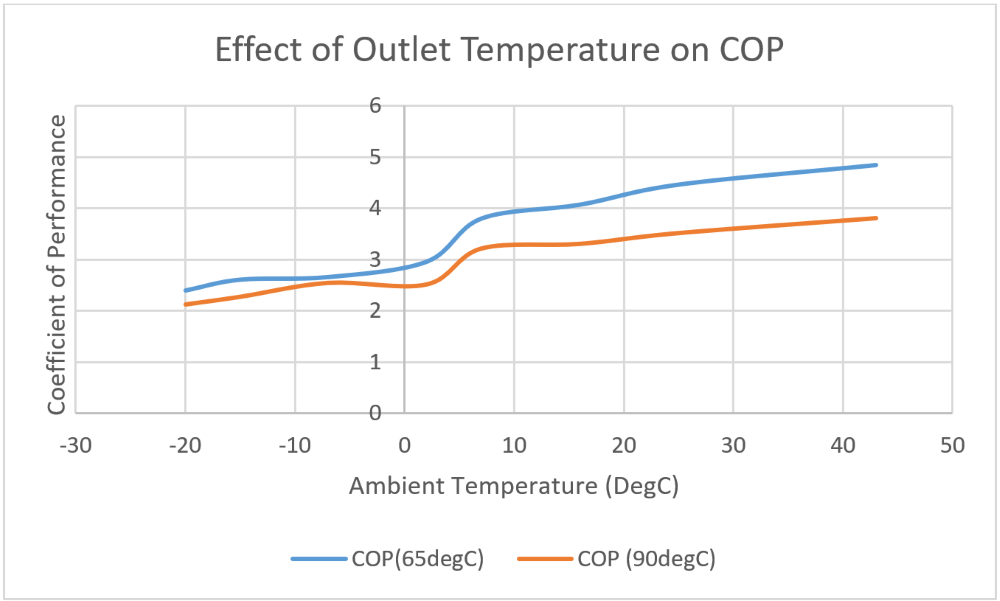
I know the air a heat pump kicks out is considerably colder than what a gas furnace produces. The cop for heat pumps tends to range from 3.2 to 5.2, depending on the same criteria as before. It is possible for heat pumps to reduce energy consumption by up to 72%, depending on the type of pump you are using and also how insulated your home is.
Today with the thermostat set at 70*, the indoor air temp was 65*, inlet air at the air handler was 65*, and the outlet air temp (at the closest vent, about 4ft of ducting away) was 70*. If approach is to high the system will get to hp fault. The ideal or rated condition for the heat pump is 80° f air temperature, 80% relative humidity, and 80° f water temperature.
It’s the difference between the temperature the heat pump puts out and the temperature which returns to it from the heating system. Outdoor = 23'f, indoor = 68'f already. While heat pump is trying to raise temperature by 2'f.
When used to heat a building, the energy is transferred from the outside into the building. As standard , the switch is rated for use up to 80c. Your heat pump should produce cool air at 52 to 57 degrees until the indoor temperature cools to 72 degrees.
The term “temperature differential” is something we use widely in the hvac industry because it helps us figure out if an air conditioner is working properly or not. On a 20 degree day, it might drop to 85 degrees.